Lesson 3: Learning Biology
Are you interested in earning a Bachelor's of Science degree? Biology is a fascinating field of study!
The goal for this lesson is to understand the importance of the cell and its characteristics in the evolution of all species.
The main objectives are:
- Learn the difference between prokaryotic cells and eukaryotic cells
- Differentiate the different structures of the eukaryote cell and their functions.
- Learn the concepts of cell division.
- Learn to classify the different species.
- Apply the concept of species organization and relate it to the real world.
- Learn about the rules of genetics and their application into genomical statistics
For students who require a deeper knowledge of this topic, special classes can be offered.
Resources for Learners
Cells: https://quizlet.com/325492818/biology-cells-flash-cards/
Mendel laws and basic genetics: https://quizlet.com/288360128/mendel-laws-flash-cards/
In the links provided you will find several exercises covered during the class.
Recomended bibliography
Biology. Solomon, E., Berg, L., & Martin D. 9th Edition. Cengage Learning. 2010
ISBN0538741252, 9780538741255
Units
-
Organization of the Cell
-
Biological Membranes
-
Cell Communication
-
Energy and Metabolism
-
How Cells Make ATP EnergyReleasing Pathways
-
Photosynthesis Capturing Light Energy
-
Chromosomes Mitosis and Meiosis
-
The Basic Principles of Heredity
-
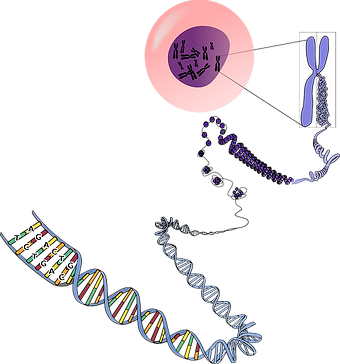
DNA The Carrier of Genetic Information
-
Gene Expression
-
Gene Regulation
-
Introduction to Darwinian Evolution
-
Speciation and Macroevolution
-
The Origin and Evolutionary History of Life
-
The Evolution of Primates
Absorb activities
You know it, because you see it?
When one of your parents' friends says: "Oh, you've got your mom's eyes!" and several phrases like that, this refers to genetics, more or less. With time we realize there are several characteristics in us we can relate to our parents, or relatives, maybe your chin is like your grandpa's, or your cousin has your nose, or not? Well, you know the result of a complex and amazing evolution process, and reduce it to what we see would be just simplified. There are a lot of things we might know but not see it, so watch the video and be amazed by the beautiful world of genes and codons.
Follow the Youtube channel, as it has a lot of didactic materials related to Biology, be sure to check it out!
https://www.youtube.com/channel/UCX6b17PVsYBQ0ip5gyeme-Q
Genetic Activity
Now, let's see how well do you creating your own family tree.
Gather all the physical information possible about your parents family, like eye colors, hair color, hair type, or anything you think is a good feature, and ellaborate on your own family tree, like the example below
Once you are done, just send your file to your instructor by email (jstumpfs@g.emporia.edu)
The tree must show the following:
1- Physical characteristics from your grandparents, your parents and their siblings, and your siblings as well.
2- In a chart make a comparison of your relatives regarding their characteristics, and explain if its a recessive or dominant gene.
If all characteristics are fully addressed, that's a 100%
If partially addressed, 75%
Not addressed, 0%.
Summary
In this module you learned:
1- The eukaryotic cells are more evolved, developed cells, that have a nucleus and complex cell structures, while prokaryotic cells are the primitive cells.
2- Each structure of the eukaryotic cell has a main function but they all work together.
3- The species can be classified in microscopic and macroscopic.
4- You learned about the species organization, and how they relate to other species.
5- Genetics Laws help to determine how physical characteristics are developed and passed from generation to generation.
